Showing posts with label documentation. Show all posts

Monday, May 25, 2009

Presentation Focus


Most SDI students have completed their first presentation and this has helped many focus on exactly what products they hope to produce by the end of the course. Some students have made considerable progress on their projects while others appear to be just getting underway now.

This year's class have had less class time that last year's and it's showing up in less project documentation - as well as fewer teacher presentations. We've decided to run classes on Tuesday afternoons for a while to address this. It already appears to have had an impact because almost 3/4 of the class completed significant documentation last week.


I've shown a few slides from different presentations in this post. This week students will hopefully display these on their own journals.


Monday, April 13, 2009

Building SDI Journal Posts

Your SDI journal provides documented evidence of your experience, skills and understanding of:

  • project management
  • communication
  • project implementation
  • research
  • In other words the journal provides formal evidence supporting the four criteria for the course.
To achieve your desired final award it can help to structure journal posts so that they include four components:


  1. Description
  2. Analysis
  3. Reflection
  4. Connection


1. DESCRIPTION

  • What have you been doing?
  • How did you do it?
  • What resources did you require?
  • Who did you need support from?

2. ANALYSIS

  • What were the results?
  • How did it work?
  • Which research does this relate to?
  • What pattern or trend is emerging?

3. REFLECTION

  • How do you feel about what has happened?
  • Have the results met your expectations?
  • What have you learned? What has surprised you?
  • What questions have emerged?
  • What planning, knowledge, skills, resources... do you need for your next step?

4. CONNECTION

  • What connections have you made with people, organisations, theories, ideas...
  • Reply to comments others have made on your post (come back later and check).
  • Comment on other journals in the SDI class - or journals/blogs/forums related to your project.

Don't forget to include pictures, graphics, screenshots, video clips, audio, links to relevant sites to enhance your post. If you don't have any multimedia clipart such as the one in this post can help illustrate a point as well as make your journal more interesting for the reader.

Not all posts will include all these elements but over 2 or 3 posts you should cover most of them.

Heather and I will make comments on you posts to help you - and you can comment on each others posts to do the same :-)

Tuesday, December 2, 2008

On the Road...

Since completing this course and seeing the excellent results obtained by students - results that I partly attribute to our use of ICT to provide a flexible and personalised learning environment - a number of teachers have asked to hear more.


Uploaded on authorSTREAM by regor2012

I've prepared a presentation to help me explain why we chose particular Web 2.0 services, how students used them and why I think they contributed to higher than expected student achievement in the course.

Later today I'm hoping to get some feedback from teachers at another college during the presentation through Blogger and Twitter to show a little of how Web 2.0 services function.

.

Thursday, August 28, 2008

Google Reader Common Sense

Common Craft have just released a "Plain English" Google Reader video.


I have 106 Google Reader feeds - 55 are student journals. Journal posts for the SDI class now total 370 - easily managed with the magic of RSS.

While on stat's... Twitter posts for the SDI class have just passed 1,000 - that's a lot of activity in just one course.

I've just printed all this and it's 6cm of A4 pages - and mostly double sided printing! Thankfully I can print directly to high speed photocopiers. And every page was where I could find it - one click to open, one click to print :-)

.

Sunday, July 6, 2008

Presentations

It's been great watching project presentations to see so many projects beginning to take off as individuals and teams settle on directions and scopes. Many have commented on how they have cut back on their original ideas or changed direction... and in a couple of cases changed projects entirely.

With so many presentations over several weeks not many people have been able to view them all - and unfortunately not all were recorded. Nevertheless the slideshow on the right shows some material and there are a few video clips below made from some of the presentations.


Wednesday, April 30, 2008

Presentations, Concepts and Questions

The Glassbiscuit Development Team set a very high standard when they gave the first project presentation for the year. It was informative and well structured with clear visuals. (I'll edit this post when I can link to some of their content.) Thanks to Zoe on video and camera we will soon be able to see some of the action - and review it for future presentations.


This week we looked at concept mapping - using Cmap - an excellent tool that is easy to use and enables you to share maps online. This map shows where the tool might be used in the SDI course. Boxes in the map can contain a range of resources - such as web links.

One of the resources attached to the above 'Key Questions' box is a very useful Questioning Toolkit. Asking questions is a key part of SDI project work and research.

In other news... many excellent projects are well underway now with some high quality prototypes and products beginning to appear. Even though most projects have a long way to go you can get some sense of the range of work being done by looking at the slide show on the top-right of this page (and here) and the journals further down the right-hand column.

In particular checkout the recent work in Enigmarta Productions, Buggs Blog and Project CLOUT,

Wednesday, April 16, 2008

A Buzz in the Air

The Interactive Media and Digital Projects classes are now buzzing! The students are great and the project work is of a high quality. Everyone is either designing or making or researching... and the ideas are fantastic!

And even better - many are now routinely documenting - updating journals and activity logs, commenting on other journals, taking an interest in other projects and being part of a supportive learning community.

Last week's State Quality Assurance Meeting reinforced how important it is for students to be recording their journey. While projects may race ahead or stall or take unexpected turns it is critical that documentation continues.

Most of the documentation at the moment is descriptive rather than reflective but we can focus on more on reflection after first term reports. Another thing we need to look at is questioning... students need to be much more skilled in asking key questions related to their project. This can have a profound effect on the quality of projects.

We are progressing very well through the mandatory content for this course - and in a fairly painless fashion. We are up to our 8th 30 minute lecture and it is clear from reading journals and looking at project work that many students have taken on board the material presented.

Online research and organisation skills have also improved. To be frank these were very poor at the start of the year - and while most still have a way to go in this area it is good to see the progress that has been made.

As far as my own skills go I'm getting better at managing such a large group - 42 students now - and I feel confident that those who are aiming for the top level course are on track to achieve it.

Some my project support work has not been ideal with many students having to wait too long for items or advice that is critical for their project work. But I've noticed more students asking for, and getting help from other students and teachers which is good to see.

Some issues have arisen with students who need high enough TE scores for universities but can't count the full range of pre-tertiary subjects they have done because they include different versions of the same course. eg Art Production, Media Production and Student-Directed Inquiry are all framework courses and each have multiple course options. Hopefully we can resolve this issue through the use of folios and negotiation. This issue is far from satisfactory when one can clearly see the wide range of different knowledge, skills and understanding that students are developing.

Sunday, March 30, 2008

Assessment AS Learning


Student-Directed Inquiry emphasizes assessment AS learning rather than the more traditional assessment OF learning where testing of what you know is often carried out at the end of units, topics or the year...

Essentially assessment AS learning supports student management of their own assessment - incorporating assessment FOR learning and even some assessment OF learning as required. It is about SELF assessment.

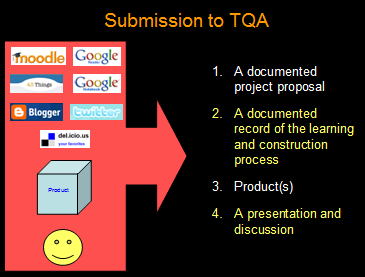
This course has FOUR criteria or ‘dimensions’ of learning. For each criterion we are looking for documented evidence of a range of ‘elements’. See presentation.

Learning and research tools can provide ways to capture, edit, organise and share work.

Regular use of these tools can help to improve the efficiency and quality of the documentation process required by the qualifications authority. These same tools also enable students to:
  • participate in learning communities
  • engage in accountable communication
  • manage learning and assessment
  • organise, authenticate and reference research
This level of self assessment will be new for many students - and may be challenging for some. Hopefully however it will become a natural part of the learning process and be fairer, more transparent and more useful than traditional assessment methods such as a three hour written exam.

Friday, March 21, 2008

Knowing What You Don't Know

Australian universities are calling for a new kind of learning, and a new kind of student - for 21st century success in work and life - personally, nationally and globally .

The new learning is about somebody who
  • knows what they don’t know
  • knows how to learn what they need to know
  • knows how to create knowledge through problem solving
  • knows how to create knowledge by drawing on information and human resources
  • knows how to make knowledge collaboratively
  • knows how to nurture, mentor, and teach others
  • knows how to document and pass on personal knowledge
In many ways the TQA subject Student-Directed Inquiry on which this course is based is a response to this call.

The document New Learning: A Charter for Australian Education goes on to say that good learners are able to
  • take the many different kinds of raw material in the world (culturally and location-specific information)
  • work out the different interpretative frameworks within which that information sits (different worldviews, theories, belief systems— professional, cultural, technical)
  • use these understandings to do something that works in the world (transfer of understandings, transformation of their immediate world, being a change agent, crossing a cultural boundary)
This week's 30 minute presentation introduced students to some of the beliefs, assumptions and worldviews that underpin contemporary western culture. It began with a quick online survey of the personal beliefs and assumptions of the class. The survey contained the following statements among others:
  1. Thought is due to brain activity
  2. Reasoning is the highest human skill
  3. The best way to understand something is to take it apart
  4. Love is mostly a chemical/ hormonal reaction
  5. Ultimately there is little purpose to human life
The majority of the 30 students who completed the survey appear to hold beliefs and assumptions arising from positivism, reductionism and materialism. Have they questioned these assumptions? How will these assumptions affect their project and research methods? How do they affect their views of the future of the world?

While more than half believe that the planet does not have a positive future 87% believe that learning is a natural human activity and 94% believe that there is still much to discover - maybe the future will be more positive than they believe :-)


The presentation this week looked at the nature of a 'worldview' and then went on to propose that having a conceptual framework such as Four Quadrant Integral Theory allows one to look for what we may not be seeing...

While there was applause for an entertaining presentation some are not convinced that this discussion has anything to do with their project or research... I look forward to some interesting conversations...

Wednesday, March 5, 2008

Mimio Handles Complex Game Plan


The Glassbiscuit team moved their planning to the whiteboard today - recording their ideas to a laptop using Dirk's favourite device - the Mimio :-) This team of six certainly needed the space - not just because they are a large production team but because their project is large and complex.


For documentation, collaboration and file sharing they have chosen to customise the free hosted Wikidot. It's well organised and has RSS feeds for easy feeds - once they adjust the security setting so we can access it :-)

A critical issue with such a large project team is the ability of each team member to be able to document both their individual and collaborative work. This is required for assessment at the highest level of the Student-Directed Inquiry course.

The level of organisation and documentation that the team has put in place should address this very well.

Another aspect of the group's planning involves P.H.A.S.E.

According to their FAQ:

"P.H.A.S.E. (Project HAndling System Environment), is a scheduling system designed (soon) to set deadlines for the completion of all aspects of the project. Once a "phase" is complete a new playable version of the game will also be completed, meaning that we will not be left with a bunch of incoherent stuff at the end of the year, but a finished project and a graphic representation of the path we took to create it."

Sounds like a great idea!